
Good morning. My name is Claudia. You now know my name and I sincerely hope that during the coming months, you will come to know me, and I you. Thank you for the opportunity to be here with you today and serve this Congregation as your intern minister. This is truly the beginning of an exciting adventure for you and for me, and for that I am grateful.
I have been a religious educator for the last 16 years, and for many years felt the call to ministry. However, the demands of motherhood and work made heeding the call difficult. Now that our children are on their own, and my school board service in Indian River County is ending, the timing is right. I just completed the first year of seminary and I am officially a ministerial candidate.
This first year of seminary has been a transformative, challenging journey that has truly changed my life and how I engage with the world. I have slowly been adapting to the life of a student traveling to Chicago for classes a few times a year and juggling work, assignments, and family. An important part of my seminary work has been exploring UU history, theology, religion and spirituality, and deepening my understanding of Unitarian Universalist ministry so that I can discern which area of ministry best fits my skills and interests. I look forward to the work we will do together as we walk this journey of spiritual growth, building relationship and ministering to our hurting world. I know you are a Congregation committed to social justice. I look forward to learning about and partnering with you on your outreach projects. As I prepare for our work together I’d like to share a definition of ministry that informs my approach to this sacred work. The author is unknown.
Ministry is the act of ministering to. It is the way we are mindful, and nurturing of each other. Ministry is not something only ordained ministers do. When we care with someone, when we stand with them through struggle, when we help them learn and grow, we are engaging in ministry. When we offer programs that engage the heart, the mind or the spirit we are engaging in ministry.
I look forward to engaging in ministry with you over the next two years.
When we care with someone, when we stand with them through struggle, when we help them learn and grow, we are engaging in ministry.
In order to minister to others, we have to take care of ourselves, minister to ourselves. In our personal lives we also have to stand through struggle, and be willing to learn and grow as we face challenges. This requires adaptability; being able to adjust to change. Often what comes to mind is the adaptation of organisms in nature that we learn about in science. Adaptations allow organisms to not only survive but thrive in a particular place or habitat. This understanding can be applied to how we adapt to changes in our lives and society so that we not only survive the situation but are able to live fulfilling lives and continue to thrive.
Struggling through situations, welcomed or not, requires our willingness to question our thoughts, feelings and beliefs about the situation we are in. Can we change the way we think about a situation? Can we look at evidence, examine facts, and maybe even change our mind about a conviction or belief we have held a long time that is not supported by the evidence? Learning and growth require the willingness to engage new ideas and perspectives. Being open to change is what allows us to adapt to circumstances in our lives and the ever changing world around us.
In 1993 our family moved to Bahia, one of the poorest states in Brazil, with an infant and a toddler. We lived in the town of Cruz das Almas where there was water every third day, limited access to medical care, no air conditioning, as well as rampant inflation: food prices increased daily. These are, of course, only a few of the many details we had to deal with when our family moved to Brazil. I could have felt sorry for myself, complained to my husband (or even blamed him for putting us in this situation) and started counting the days until we left…or I could have found a way of making the best of it. I decided to do the latter and by the time the three years were over…I didn’t want to leave. I had adapted to my new environment.
You may have heard the saying: “You can’t direct the wind, but you can adjust your sails.” Those years in Brazil taught me to adjust my sails. I learned that we have it within us to transcend many of the hardships and losses we face if we are willing to embrace change rather than fight it; if we are willing to adapt and be transformed.
From the moment of birth we experience change. We leave the comfort and warmth of the womb to enter a sterile, cold, harshly lit hospital room -- if we aren't fortunate enough to have a home birth.
We nurse, and are weaned.
We start school.
Our parents may divorce.
We lose a pet.
We move to another neighborhood, state or country.
A parent dies.
A job is lost.
A young adult leaves for college.
A spouse is diagnosed with Alzheimer’s
And the list goes on.
Each change requires a transition and maybe even the acknowledgement that there has been a loss. We often think of loss and grief as responses to death or catastrophic events in our lives. But sometimes it’s unfair situations, big disappointments, life milestones, serious heartaches or the reality of aging and confronting one’s mortality, that lead to significant transitions in our lives.
Acknowledgement, and maybe even a grief reaction that allows feelings and one’s sense of vulnerability and loss to be expressed can be cathartic.
Life transitions involve a change in how we define ourselves. There is a shedding of a previous identity, a new way of seeing ourselves regardless of whether the situation is happy or sad.
In our story today, Pete the Cat just went with the flow, and in the end “it was all good.” It isn’t really always “all good.” However, we can choose how we deal with change and feelings of loss.
But it is not only changes in our lives that call us to be malleable. There are many changes happening in our society that often place us at odds with each other regarding important issues such as reproductive rights, sexual identity, race relations and presidential nominees. Furthermore, we have experienced a shift: the white Eurocentric majority's hegemony is being disrupted by the increasing numbers of the "minority" population. Recently, at a school board conference I heard a presentation on the “browning of America” describing how many school districts throughout the country are becoming minority majority districts. Teachers are often not equipped to deal with the diverse cultures and needs of their students. This shift can be unsettling for those who are accustomed to being in the majority. It can make people feel uncomfortable, resentful and angry.
President Obama alluded to some of these issues recently when he spoke to the graduates of Howard University, reminding them that identity politics can obscure common goals and be so caustic that they bleed into hatred. “Even well meaning advocacy groups can make matters worse,” he said by “keeping their members agitated as much as possible, assured of the righteousness of their cause.” He insisted that change “requires listening to those with whom you disagree and being prepared to compromise.”
His words were particularly compelling when he invited the black students at Howard University to “expand their moral imagination” imploring them to recognize “the middle aged white guy who you may think has all the advantages, but over the last several decades has seen his world upended by economic, cultural and technological change, and feels powerless to stop it. You got to get in his head, too.”
Isn’t this what being open-minded is all about? Entertaining diverse approaches to complex oppressions, and trying to understand others instead of demonizing them. How can we respect each other’s inherent worth and dignity while disagreeing profoundly on issues that are important to us? This is a question we need to reflect on as a nation experiencing deep partisanship, xenophobia and religious intolerance fueled by fear, ignorance and political pandering.
What can we do?
We can be willing to listen and try to understand the perspective of those we disagree with.
We can try to find areas of commonality we can work towards. This can help us establish relationship and familiarity with each other. There are no easy answers, but President Obama’s words call us to remember that change affects all of us. How we respond to change is our choice.
May we expand our moral imagination to include those who do not think like us.
May we choose to respond to change with love and compassion, rather than fear and anger.
May it be so.
Adaptability & Life Transitions, a sermon delivered by Claudia Jimenez at 1stUUPB, May 22, 2016.

I want to tell you a story of adaptability. That is our theme this month. The story is my story -- the story of my arrival in south Florida in 2013. Now you should know that I had never thought of living in Florida -- not once. Sure, perhaps a visit here and there, but never considered living here.
In the spring of 2013 three congregations were put before me by the UUA’s Office of Transitions to consider, and I bet you can guess which congregation I thought was the best match. I drove from New York, stopping in Baltimore and Savannah arriving here on July 13, 2013. I remember the day well. It was the day I needed to pull over to the side of the road because it was raining so hard I couldn’t see inches in front of me. Then, to my amazement, three minutes later the sun was shining without a cloud in the sky and it was hot.
I mean hot. Mucho caliente. While in my air conditioned vehicle I was fine. Once I stepped out I lost my breath to the heat and humidity and I began to sweat just walking a few feet. My thick and lethargic northern blood did not serve me well, but I adapted. I remember scheduling a weekly gardening group here and no one came. I was later told that I was nuts to ask people to be outside between the hours of ten and two.
I didn’t know, but I adapted. In the north I wore a robe on Sunday mornings, most ministers do. I did wear a robe here in July and August and found myself dehydrated and feeling faint after one hour. I learned I was wearing a portable sweat lodge. There is no need to put on a heavy robe in the Florida summer. I hung the robe up and adapted. I arrived wearing black clothing. Nearly everything I owned was black. Did you know that the color black draws the sun and the heat to you? I have diversified my wardrobe and have adapted. I mean look at me now. I look like the Easter Bunny in Miami for god’s sake.
I’m telling you this story of my adaptability as a way to demonstrate that when we arrive in a new place, a different place, a place that requires us to change to survive, we need to adapt. You see it is no longer about the survival of the fittest. It is about the survival of the versatile.
Human adaptability focuses on the flexibility with which humans, both as individuals and as populations, cope with challenges and changes. The Rev. Mark Wilberer asks us, "Just how adaptable are we -- or is human adaptability only a myth? And why do I gripe about that kid hot-rodding down the street and -- my god! -- didn’t that just sound like my dad talking?" We may here ourselves say, “kids today” or “Get off my grass and stay off!” That sounds like my grandfather. My grandfather had built his home, his sanctuary, and when his sanctuary was breached and he became uncomfortable with the changing times he would become even more guarded and monitored his grass closely. In his day people used the sidewalks and respected your grass. His response to change was to scare kids away who dared step on his grass.
The Rev. Scott Alexander, our guest speaker last week, tells us to “adapt (adapt in the heart, mostly), in order to get our lives moving again in light of the new information we have been given about what is now possible for us.” Possessing an adaptable heart means possessing a heart that is willing and able to align itself to conform and move with new information about what is possible, a heart that is open to finding fresh new channels of living in the face of change, howsoever challenging, is the key to emotional survival and successful living.
What are the needs that we are meeting with this behavior? Just as Darwin’s orchid developed a range of mechanisms to survive and to thrive, so we do the best we can, with the tools of mind and emotion and imagination to survive and to thrive physically, Above all, we need to feel we exist, and that we are safe — we need to feel both present and secure. I am convinced that these very basic emotional needs lie at the heart of all kinds of behaviors.
I’ve had many conversations with our older members. I love the stories that are told. One thing all of these conversations have in common is how much the world has changed. I always get feedback that I use email too much instead of face to face conversations. Think about it -- we can have a circle of friends on Facebook where we know all that is happening in our lives without ever meeting face to face. I don’t own any vinyl records, eight tracks, cassettes or CD’s. I store everything on my iPhone. Times have certainly changed and I wonder how you manage the discomfort that comes with such changes. When all that you know, when your sanctuary, not unlike my grandfather’s, is breached. Have you experienced anything like that?
Impermanence is challenging emotionally, physically, intellectually and spiritually. We desperately try to stop and prevent change. However, riding the wave of change, embracing change, permitting change and impermanence in our lives allows us to grow.
Perhaps you have had the reoccurring realization that life changes and we find ourselves waking up to a new world each day. We never really grow accustomed to this new life every day but we think we do. It is work, spiritual practice, to increase our comfort and to adapt -- to stop yelling at the kids on our grass. The big spiritual question to ask ourselves is, “How have I changed?” Paying attention to the practice of stepping aside and taking stock of our adaptability is checking in on the evolution of our spiritual selves.
Oxford professor AC Benson writes, “As I made my pilgrimage through the world a certain sense of mystery seems to gather and grow. And this is the vision I have for my life on the good days when I’m able to stand back and get some perspective.” What does that mean for us? We want to have something constant in our lives and the only thing that is constant is change. Perhaps rather than posting “Get off my grass” signs demonstrating our inability to adapt we might think about making it through life striving to be adaptable. Ask yourself, “What do I want to do to be relevant in this life; to be adaptable?”
The world keeps changing. It doesn’t help to become attached to a single way of being in the world. I’m reminded of the Buddhist teaching of non-attachment. The Dalai Llama writes, “Attachment is the origin, the root of suffering; hence it is the cause of suffering.” The human mind loves to process thoughts and is sticky like glue. That means it attaches to feelings and thoughts, not unlike a prisoner who is holding on to the prison bars. This is the nature of the mind. Non-attachment is about observing, being aware of your feelings and thoughts without grasping at them. Imagine flowing through life with non-attachment. I do not know anyone who is able to take change completely in stride. There are so many complex feelings and behaviors associated with change. It is unsettling; it pulls us out of our haven of security and presents us with something different. It takes away our illusion that we can predict the future, it takes away our illusion of control. It means we lose that which we have known. Whether we hated the status quo or loved it, whether we were comfortable with it or not, change is often deeply frightening and always anxiety producing. Maybe we're not up to it; maybe we can't handle it. Change brings us loss just as often, if not more so, as it brings us gain. We reflect all of these feelings in the ways we react to change. So how in the world are we supposed to cope with it?
I think coping with change is a practice. It isn't something we do once and master, rather it is something we are called to do over and over, with mixed results. The greater the change the harder the practice. Yet the better we cope, the more free we are. How helpful is it to deny or fight a reality that is already here? Or to overly clutter our lives with attempts to control everything and everyone? We can get so caught up in resistance that we leave the present moment, the current now-ness of our lives. And since this moment is all that we have, really, what is our life if we cannot accept it? Change is hard, yes. It brings loss, it brings sorrow, yes. It also brings opportunities for growth, for learning, for happiness. Change per se is neither good nor bad; it's what we make of it. Why not attempt to make meaning of it, to find a greater purpose through it? Why not meet it with the bravery that I know is inside us?
So, will you start dressing like a Miami Easter Bunny or will you sit by the window peeking through the curtain waiting for your grass to be walked on so you can shake a stick at those kids today? Will you choose to be relevant and adapt, understanding that your commitment to embracing change will help you grow. Change is a part of our lives. The question is, What are we going to do with it? How are we going to live with it? In being with our changes, may we be wise, may we be courageous, may we be open. If we must know its bitterness, may we also know its sweetness. "For all that is our life, we bring our thanks and praise." May it be so.
Get off My Grass, a sermon delivered by the Rev. CJ McGregor at 1stUUPB on May 15, 2016.
The first Board of Trustees meeting of the new Congregational year was held on May 10, 2016. Here are some of the highlights:
The board approved the continued appointment of Jennifer Hommel as Coordinator of Religious Education and Nursery Care Provider. We appreciate Jennifer’s dedication to this role.
The board approved two new Committee Chairs: Gary Evans, Membership; Larry Stauber, Sanctuary Services. Sylvia Ansay has been appointed to serve on the Committee on Ministry. Thank you Gary, Larry, and Sylvia!
The Board also approved the formation of a Leadership Development Team as a Special Committee of the Board. Thanks to the Leadership Development Research Team for their reports on leadership development in other congregations and their recommendations to the board: Allan Maxwell, Creighton Lederer, and Chari Campbell who served as chair of the task force.
The board also discussed and agreed upon access to information in the new Breeze software system information. Thank you Nickie Albert for leading this initiative, and Harry Wolin and Barbara Hatzfeld for their implementation work. If you have an email address and have not received an invitation to register on the system. Please contact Barbara or Nickie.
A Board retreat is planned for June where we will begin to develop goals for the Congregation, for the board, and for our developmental ministry. Suggestions from the Congregation prior to the retreat will be welcomed.
Next Sunday, the prospective intern minister will lead the service and answer questions during coffee hour. At the June board meeting, the board will make a final decision on having an intern minister . Please make a special effort to attend the service next Sunday and let members of the board have your feedback.
We will also be making a decision on repurposing the Thrift Store space. Please share your thoughts about repurposing the space with the President. We won’t be able to please everyone, but we want to know what you think.
Paul G. Ward
President, Board of Trustees

(From an episode of The Simpsons, set at the church ice cream social)
Lisa: “What flavors do you have?”
Rev. Lovejoy: “Well, chocolate, vanilla, strawberry, and our new Unitarian flavor ice cream.”
Lisa: “I’ll have that” (Rev hands her an empty bowl)
Lisa: “But there’s nothing in there.”
Rev: “Eeeexactly.”
We Unitarian Universalists are an interesting bunch. Some of us arrive here knowing we have the truth and things figured out; some of us believe we have the truth, but are open to mystery and wonder-revelation. Heck, even our fifth principle tells us that we are on a journey together to seek the truth in love. Those outside of Unitarian Universalism say we believe anything or we believe nothing. I’ve been thinking about how Unitarian Universalists may dismiss or scoff at things they cannot see, hear, and touch. How can we be so certain when we don’t know what we don’t know. I know you don’t know what you don’t know and I know that you know that that I don’t know what I don’t know. You know? There is mystery, indeed.
Let me tell you a story from my own life. I’ve shared with you that my early childhood was traumatic and my relationship with my mother was strained until her death. However, there are bits of my childhood where my mother is concerned that I cherish. In the evening I would often find my mother stretched out looking at the stars. We lived in the foothills of the Adirondack Mountains so you can imagine what the night sky might look like. Broad, open, and filled with stars. I would join my mother and stargaze with her. It was in those moments that my mother was calm, generous, and loving.
We talked about everything especially the mysteries of the universe. What was out there? What were the possibilities? We realized there was so much that we didn’t know about the universe and other mysteries. Those moments are seared in my mind as precious memory of my mother and a special time that we shared together. That is the why of experiencing mystery and wonder. So that we can have moments of awe that keep us connected with others, so that we can remember times of shared living, so that we can continue to be in awe of the universe, and so that we can share our enthusiasm for life and love and affirm a willingness to approach one another with an open heart, an open mind in ways that support mystery and awe.
The phrase "I know that I know nothing" or "I know one thing: that I know nothing", sometimes called the Socratic paradox, is a well-known saying that is derived from Plato's account of the Greek philosopher Socrates. The phrase is not one that Socrates himself is ever recorded as saying, and there is some disagreement about whether it accurately represents a Socratic view. If it were not for Plato we might not know a lot of what Socrates said. Plato investigated Socrates's explanation of that aspect of his philosophy often termed "the Socratic Paradox." Socrates believed that we all seek what we think is most genuinely in our own interest. (Obviously, short-term pleasure or success is often not in our best interest. The long-term effect on the soul is, however.)
On the one hand, if we act with knowledge, then we will obtain what is good for our soul because "knowledge" implies certainty in results. On the other hand, if the consequences of our action turn out not to be what is good for our soul (and hence what is genuinely not in our self-interest), then we had to have acted from ignorance because we were unable to achieve what we desired. In a sense, then, for Socrates, there is no ethical good or evil in things in the world — things are what they are. Instead, "knowledge" is considered to be materially equivalent to what is "good," "excellence," and "ignorance" is considered to be materially equivalent to "evil" or what is "harmful to our soul." If harm happens to us, then, at some point, we had to have acted with a lack of knowledge. In this manner, Socrates concludes, what to many persons seems paradoxical, that we are "morally responsible" for obtaining all the knowledge we can. In this sense, ignorance is no excuse.
Let’s go back to the paradox. The meaning of the word "paradox" itself.. the word’s origin is Greek.. the prefix ‘para’ means beyond and dox from the Greek meaning opinion or belief. So the literal meaning of "paradox" is "beyond belief". The best word for something beyond belief, it seems to me, is “mystery”. In our quest to be part of the greater, unseen, unliteral world of creative power and mystery, we must consider faith and mystery. As Unitarian Universalists we affirm and promote seven principles, which we hold as strong values and moral guides. We live out those principles within a “living tradition” of wisdom and spirituality, drawn from sources as diverse as science, poetry, scripture, and personal experience. There are six sources and we will focus on the first today which is “Direct experience of that transcending mystery and wonder, affirmed in all cultures, which moves us to a renewal of the spirit and an openness to the forces which create and uphold life.” That source instructs us to have an openness to the forces that create and uphold life and to the forces that take life.
One of our preeminent theologians of the 20th century, James Luther Adams, said it like this: “Religious liberalism depends on the principle that ‘revelation’ is continuous.’” It means that the only kind of bible a Unitarian Universalist could believe in is a Wikipedia-type bible. It means that, when Unitarian Universalists read the Hebrew bible and the Christian bible in a way that is faithful to our theological tradition, we never read it literally and in a way that assumes the ancient message — the meaning of it — is frozen in the amber of time. Always, we are finding ways to value the old insights in the context of their time, and to evolve the old insights so that they can serve new understandings and new needs. We believe in evolution.
The hymn that we sang, Light of Ages and of Nations #189, is set to an older hymn tune. The words were written in 1860 by the Unitarian minister Samuel Longfellow, younger brother of the more famous Henry Wadsworth Longfellow, the poet. It’s believed to be one of the earliest hymns to fully recognize non-Christian traditions. The expression in verse three is “revelation is not sealed.” But really the entire hymn is a testimony to the Unitarian Universalist beliefs that there is truth in all religions and that the potential to know truth exists in all people, of all times and places, including today, and here. The first part is about religious diversity. In our view, revelation was never restricted to one religion.
Especially today, in the present climate of intolerance, it is a powerful message. We are not new to interfaith understanding. We have a century and a half of experience from which to draw in understanding and working with our brothers and sisters of other faiths. We have an historic appreciation, written in our souls’ deep pages (as the hymn says), of the truth of their religion for them. We know that it is as true – no more, no less – for them as ours is for us. You ask what gives Unitarian Universalism power? There is power in our belief that the possibility of revelation was 1) not ever restricted to one religious group and 2) continues to be as possible as ever. We don’t know what we don’t know and should be open to the mystery.
The second part is that revelation is still possible. Ours is a “living tradition,” we like to say. It has evolved over time and will continue to do so, in large part because it is not tied to an ancient scripture or institutional creed. We do not hold onto the literal meaning of scriptures that originated in a historic context different than ours, defined by the customs and values of their (ancient) times. While we can, and do, find meaning in scriptures for our own times, the first source from which we draw is our own direct experience of that transcending mystery and wonder that moves us to a renewal of the spirit and an openness to the forces that create and uphold life. We rely on our experience to know the truth, which will set us free. I don’t know what I don’t know. Hey, I play it safe. I have no expectations for the afterlife but if I do arrive at a pearly gates rather than plead the fifth I will get in by the skin of my nose having been open to revelation and mystery.
Sometimes, our experience causes us to challenge our own faith principles. Take for example Rev. Bill Schulz, executive director of the Unitarian Universalist Service Committee. His experience encountering evil, advocating for victims of torture and opposing the death penalty, caused him to doubt the first principle that Unitarian Universalist congregations covenant to affirm and promote: the inherent worth and dignity of every person. He said in a 2006 lecture to UU ministers, “I don’t buy that anymore. I have fought tirelessly against the death penalty in this country. I have visited death rows, spoken frequently with condemned prisoners. Some of them have acknowledged their crimes and altered their hearts. Others of them are truly innocent. Many of them are mentally ill. And some of them are vicious, dangerous killers. I oppose the death penalty not because I believe that every one of those lives carries inherent worth… I oppose the death penalty because I can’t be sure which of them falls into which category and because the use of executions by the state diminishes my own dignity and that of every other citizen in whose name it is enforced. I need, in other words, to assign the occupants of death row worth and dignity in order to preserve my own. But I find no such characteristics inherent in either them or me.” So is the worth and dignity of every person inherent? “No,” he says. “Each of us has to be assigned worth — it does not come automatically — and taught to behave with dignity…” That we must draw on our own experience, and can question even our own principles, is a source of power. It’s not easy, but it engages and energizes us and therefore enables us to take action on behalf of our principles, to do the work of love and justice in this world. It gives us power.
Ongoing revelation, questioning, transformation… with so much change, what lends stability to our faith tradition, which we sometimes even call a “movement” rather than a “denomination,”? The word “religion” means “to bind together.” By what are we bound? We are not bound by creeds, but by covenants. We are bound by promises we make about how we will be together. We call them covenants, a Biblical word. Our members covenant with new members, and congregations covenant with each other, as member congregations of the Unitarian Universalist Association. So, grounded in covenants, empowered by our belief in ongoing revelation, what is it all for? Is it all just for us, individually and collectively, or are we empowered for something larger than ourselves, this congregation, this movement? One of the joys of belonging to a free faith is the right to wrangle with questions like these. Human beings have asked themselves such questions over and over again, and, not surprisingly, have come up with different answers. We can only invite one another to ask the questions because we believe that faith is a journey and “revelation is not sealed.” Change is constant. We honor the great mystery as one of our sources of our faith. We don’t know what we don’t know and must be open to that.
The author Rabi Michael Lerner is a political activist and rabbi at a synagogue in Berkeley, Ca. He is editor of a progressive magazine focused on social and religious activism. He is chair of the interfaith Network of Spiritual Progressives, rabbi of and author of eleven books, including the national best-seller The Left Hand of God: Taking Back our Country From the Religious Right. His sentences, “It is the reality of human experience that at our core we respond to the universe with a sense of awe and wonder at creation.” And “We are dazzled by the incomprehensible fact of being itself.” are to my mind the deep thoughts behind our first source. We cannot not seek for the sacred, the mystery, and the wonder which moves us to renew our spirit and opens us to the forces that uphold life. It is part of our DNA, part of our being; it is the essence of our humanness.
So we look and we wonder and we search and we argue for and against, and we believe, and we don’t, and we change our mind, but the reality, as Rabbi Michael Lerner reminded us, is that at the core of the human experience we respond to the universe with a sense of awe and wonder and we are amazed by the incomprehensible fact of all of existence. Exploring your thoughts and beliefs, your experiences your ideas is what can deepen your spiritual self.
Here are some thoughts I would like to leave you with: the universe is richer than we can imagine; life is more mysterious than we can find answers to; human nature will always want to know the why, the what and the how. Being a religious, spiritual person is the how. Let’s together find the fire in our faith and use it to light a path to a future, more just, more loving world.
May it be so.
Knowing You Know Nothing, a sermon delivered at 1stUUPB by the Rev. CJ McGregor on April 24, 2016.
President’s Bully Pulpit #12
April, 2016
To all the members and friends of 1stUUPB:
Thank you for giving me the opportunity to serve as your president during 2015-16. It has been an honor and a privilege to lead our Congregation throughout this church year.
I want to give special thanks to the members of the Board of Trustees, the chairs of committees, and the members of Team 7 Stewardship Campaign, for all the wonderful volunteer work they have done during my presidency. I am especially indebted to staff member Barbara Hatzfeld, our church office administrator, for her assistance and cooperation.
There is a person upon whom I have relied more than any other. She is a very hard working and highly capable individual. She has served as the temporary recorder of Board minutes. She has been a leader on Team 7, the Stewardship Campaign Planning Committee. And she is the principal facilitator of our popular Dine Around fund raisers. I am speaking of my life partner and friend of 62 years, fellow Baltimorean and Forest Park High School graduate of February ’57, Phyllis Levin. Thank you Phyllis for all your efforts and for all that you have helped accomplished for our Congregation. 1stUUPB could not have a better friend. Nor could I.
Beginning on May 1st, Phyllis and I will be scaling back our participation in church activities. We will be Friends of the church and visit on occasion to attend services and Teaching Thursday programs.
I wish my successor in the presidency, Paul Ward, all the best for the coming year, and pledge that I will continue to take an interest in Congregational life going forward. Phyllis and I hope we will have lots of opportunities to socialize with our church friends. We are heading to Alaska in June for a new travel adventure.
Andrew Kahn
A priest and a nun were lost in a snowstorm. After a while, they came upon a small cabin. Being exhausted, they prepared to go to sleep. There was a stack of blankets in the corner and a sleeping bag on the floor but only one bed. Being a gentleman, the priest said, “Sister, you sleep on the bed. I’ll sleep on the floor in the sleeping bag.”
Just as he got zipped up in the bag and was beginning to fall asleep, the nun said, “Father, I’m cold.” He unzipped the sleeping bag, got up, got a blanket and put it on her.
Once again, he got into the sleeping bag, zipped it up and started to drift off to sleep when the nun once again said, “Father, I’m still very cold.” He unzipped the bag, got up again, put another blanket on her and got into his sleeping bag once again.
Just as his eyes closed, she said, “Father, I’m sooooo cold.” This time, he remained there and said, “Sister, I have an idea. We’re out here in the wilderness where no one will ever know what happened. Let’s pretend we’re married.” The nun purred, “That’s fine by me.”
To which the priest yelled back, “Get up and get your own stupid blanket!”
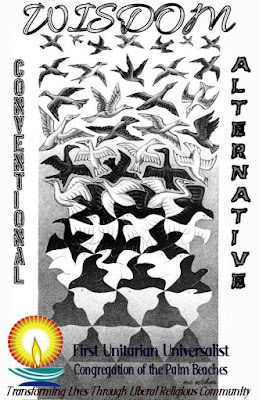
There are two types of wisdom. The most common type of wisdom is conventional wisdom. This is the mainstream wisdom of a culture, "what everybody knows," a culture's understandings about what is real and how to live. The second type is an unconventional and alternative wisdom. That wisdom questions and undermines conventional wisdom and speaks of another way. Now conventional wisdom in the story of the nun and the priest tells us the appropriate relationship between nun and priest and the familiar perception of married couples.
What are we to learn from conventional wisdom and as Unitarian Universalists should we challenge it? I turn to the work of Biblical scholar Marcus Borg for help. Much of what I ask you to consider today is drawn from his book Meeting Jesus Again for the First Time. Borg was a leading liberal scholar and theologian. He was the leading scholar of the historical Jesus. That is, he attempts to reconstruct the life of a man, not a deity, using critical historical methods. Borg’s understanding was not rooted in dogma but spiritual challenge, compassion, community, and justice. That sounds very Unitarian Universalist to me. I read his book as suggested by a member of the Congregation and it gives us a lens through which we can look at wisdom today.
Borg uses the historical Jesus to name two types of wisdom. Conventional wisdom is taken-for-granted knowledge about the way things are and how to live. It’s what everyone tends to know through our socialization process and growing up. It gives us guidance on how to live, including basic etiquette and larger images of the good life, perhaps like the American Dream in this country. Generally, it teaches that if you work hard, you will succeed, and you will get what you deserve. Conventional wisdom becomes internalized and is the internal cop and the internal judge of what society generally thinks is right and wrong and should be rewarded or punished.
And Radical, unconventional Wisdom leads to an entirely new way of living, a new ethic and social vision in which one turns the other cheek, loves not only one’s neighbor, but also one’s enemy, judges not lest one be judged oneself, and does to others only what you would have them do to you. Radical, unconventional Wisdom transforms our personal sense of identity, moving us beyond what our cultural conventions say we are and liberating us from the anxieties and preoccupations that mark so much of our lives. It is a source of courage as well as endurance.
We know that conventional wisdom isn’t always the truth. Take, for example, the American dream I just described seconds ago that is conventional wisdom. It is not based in reality. If it were there wouldn’t be such disparity between the classes, racial inequalities and divides, American families who are hungry and homeless, and a government that risks the well-being of its citizens. If ideas are wrong, why do we persist in believing them and continuing the same action? The reason may be that, after we have heard something a number of times, it becomes a part of our belief system, or to put it differently, it becomes a part of the frame through which we assess a situation and act. It becomes our reality. The mind doesn't know the difference between that which is real and that which is not. Our perception is our reality.
In my own life I’ve had to defy conventional wisdom to maintain an emotionally healthy family. When Richard and I adopted our children we knew how we wanted to raise them. We knew what kind of home we wanted to build and we had hopes. We knew we wanted to raise our children the conventional way. Because our children were so challenging we needed to lose our identities of the parents we wanted to be and defy conventional wisdom and become the parents we needed to be. It was difficult and created a huge sense of loss. But because we chose alternative wisdom, radical wisdom, our children are successful today and Richard and I are still in relationship. Had we clung to the conventional. we and our children would now be at risk as adults and our relationship would be terribly strained. We released ourselves from the anxieties of conventional wisdom, wisdom that held no truth for our family.
Conventional wisdom, according to Borg, creates the world in which we live. It provides guidance about what is socially acceptable and, in the West, comforts us with the belief that we will be rewarded for hard work. Rewards and punishment are a part of our conventional wisdom. Work hard in school and you will succeed. Strive in business and you will do well. Keep a perfect house and your family will be happy.
The problem is that there’s a rather harsh backside to this wisdom. If you aren’t succeeding you must have done something wrong. If you don’t prosper than you aren’t worthy. If your family has problems you must be using the wrong dish detergent. The world of our conventional wisdom is a realm in which we measure ourselves against others. Compared to others, how attractive, prosperous, intelligent and popular are we? It is a world in which there is plentiful stress and a multitude of reasons to become disillusioned.
You see, as Unitarian Universalists we are called to redefine conventional wisdom and employ unconventional, or radical, wisdom. Wisdom that brings us closer to our values of love, compassion, freedom, and reason. What Marcus Borg helps us to see, using the historical Jesus, is that living a life engaged in alternative or radical wisdom has several dimensions: a passion for social justice, understanding the importance of life in community, and limited concern about the afterlife in favor of a transformed wisdom that requires challenging the dominating systems created and maintained by the rich and powerful to serve their own interests. Compassion as a virtue for individuals is partially blind unless it’s married to an understanding that much of the world’s misery flows from systemic injustice and then having a willingness to work to change it. He presents Jesus as a man whose spiritual experiences led him to see beyond the conventional wisdom of his day and the boundaries that it created between people. The model life he associates with this image of Jesus is a continuous journey of transformation -- not arriving at a new conventional wisdom and a new set of rules, but always challenging our conventional, rule-based way of thinking. These are exactly some of the principles to we commit to in our Unitarian Universalist faith.
Think of an issue in your life or in the world today. What does conventional wisdom say about it? Conventional wisdom becomes conventional because it has an inherent truth to it, or at least it once did. In our rush to adopt the shorthand of business, we can easily miss the subtleties and nuances that should give pause, and thought, to what we are doing. Sometimes things get said without much substance and then these things become conventional wisdom that we all go along with even though the reasoning may be flawed in the first place. Even when misguided actions are pointed out to people they often do not or cannot hear what is being said because they are doing something that "everyone" knows is right because it is "conventional wisdom". What conventional wisdom have you seen do more harm than good? What have you done about it?
How should we listen to Wisdom? We should go out of this church trying to live and move and have our being in Wisdom as the Spirit of life that helps us to love, both in deed and in truth. That requires a radical social ethic which is willing to work against systemic injustice in the world. We should try to stop worrying and fearing and being anxious, for that closes our eyes and ears to the abundance of life all around us here and now that we can savor and appreciate, even as the world is yet to be fully transformed and redeemed.
Let me share with you some unconventional wisdom:
- Before you criticize someone, you should walk a mile in their shoes. That way, when you criticize them, you're a mile away and you have their shoes.
- Give a man a fish and he will eat for a day. Teach him how to fish and he will sit in a boat and drink beer all day.
- If you lend someone $20 and never see that person again, it was probably worth it.
- If at first you don't succeed, skydiving is not for you.
- Do not walk behind me, for I may not lead. Do not walk ahead of me, for I may not follow. Do not walk beside me, either; just leave me the heck alone.
- It's always darkest before dawn. So if you're going to steal your neighbor's newspaper that's the time to do it.
- Don't be irreplaceable; if you can't be replaced, you can't be promoted.
- Give a man the fire and you'll keep him warm for one day. Set the man on fire -- and you'll keep him warm for the rest of his life.
- No one is listening until you make a mistake.
- Always remember you're unique, just like everyone else.
- It may be that your sole purpose in life is simply to serve as a warning to others.
- It is far more impressive when others discover your good qualities without your help. If you tell the truth, you don't have to remember anything.
- Some days you are the bug, some days you are the windshield.
- Good judgement comes from bad experience, and a lot of that comes from bad judgement.
- There are two theories to arguing with women. Neither one works.
- Generally speaking, you aren't learning much when your mouth is moving.
- Never miss a good chance to shut up.
- Experience is something you don't get until just after you need it.
Dare to challenge conventional wisdom every day and enjoy your journey. Question your core belief system, one that you have been told is the absolute truth. You must open your mind to the possibilities. We are radical thinkers, a community of brilliant, passionate dreamers and doers to lead the way. Just when you realize that you don’t know everything you truly start your journey.
May it be so.
Two Kinds of Wisdom, a sermon delivered by the Rev CJ McGregor at 1stUUPB, April 3, 2016.

On behalf of Palm Beach Pagans, thank you for your hospitality. We are a group of local pagans who came together some months ago in order to meet and establish a deeper sense of community. Like you, we accept people of all backgrounds and we welcome a diversity of ideas. Every one of my fellow pagans has his or her own story to tell. I hope that you will take some time later to get to know all of us a little better.
Paganism, or as some would say neopaganism, modern paganism or pagan reconstruction, is a contemporary religious movement made up of numerous different paths or traditions. Some of us are Wiccan, Druid, Asatru or Hellenist. Some of us eschew labels and follow a more eclectic and personalized path. All of these paths share three important features.
One: we look to the pre-Christian roots of western civilization for philosophical and spiritual inspiration, as well as to the indigenous traditions of the peoples of the Americas, Asia, Africa and all over the world.
Two: we recognize Divinity as both feminine and masculine, as both Mother and Father. Likewise, we believe strongly in the equality of men and women.
Three: we regard all of nature as sacred. We possess no dogma, no creed, no commandments and no infallible scriptures. We believe that every man is his own priest and every woman is her own priestess. We shy away from hierarchies and bureaucracy.
When we come together to worship in groups, such “covens,” “circles,” or “groves,” as they are called, they are often small, fluid and short-lived for we walk a path of personal revelation. Outside of brief apprenticeships, every pagan is her or his own authority.
I’m a pagan for the exact same reason some of you are Unitarian Universalists. I was raised in a conservative Christian family. The arbitrary rules and illogical dogma of the Church never sat well with me. I have always believed in a loving God and such doctrines as hell and original sin were offensive to my innate sense of right and wrong.
I was an avid reader and at the age of ten I discovered the writings of Scott Cunningham, Janet and Stewart Farrar, Gerald Gardner and Doreen Valiente. In so-called Witchcraft or Wicca, I found a religion that espoused all of the things I already believed: God is both Mother and Father. Women and men are equal. All ethnicities are deserving of equal respect. All of nature is sacred.
Some pagans believe in one God whom they might regard as “Spirit,” “Nature,” “The Universe” or “Providence.” Others believe in a Goddess and a God who represent complimentary spiritual forces that manifest the universe: similar to the Taoist idea of Yin and Yang. Some believe in many gods and goddesses. But some of us are atheists who regard gods and goddesses as representative of powerful aspects of the human psyche.
Until recent decades, the pagan movement has been predominantly a private, if not secret, affair. Even today, most pagans practice alone and are focused on self-healing and in developing a deeper personal relationship with nature. I believe that it is time, now, for pagans to assume a larger role in our communities. In an age of rising sea levels, habitat loss and the extinction of species we need pagan voices to remind us of our proper relationship with Mother Earth. Politicians can pass restrictions and companies can slap green labels on our products, but I believe that in order for us to truly walk in balance with the natural world, each and every one of us must change the way we relate to Her.
When was the last time you looked at your yard as a community of living beings rather than just as an arrangement of things you bought at Home Depot? The sciences of biology and ecology provide us with a deeper left-brained understanding of how human beings depend upon Mother Earth. Paganism inspires us to compliment that knowledge with creative right-brained experiences that allow us to make that understanding a part of our day to day lives.
As I mentioned before, I can only speak for myself. I hope you will take the time during the coffee social to allow my fellow Palm Beach pagans to share their own perspectives with you.
Today we observe the Spring Equinox, one of the eight seasonal holidays in the Wheel of the Year observed by most modern pagans. Today, the tilt of the earth's axis causes night and day to be of equal length. For us here in the northern hemisphere, Winter has ended and Spring is about to begin.
Because it marks the end of winter and the beginning of spring, the Spring Equinox has been celebrated as a holiday of renewal all over the world for thousands of years. Today, even the dates of Passover and Easter are calculated from where the Spring Equinox falls.
In the Middle East it is called Nowruz and it marks the new year among Iranian, Persian, Kurdish and Turkic peoples. Within the Zoroastrian religion and in the Baha'i Faith it is also a holy day. As a matter of fact, the English word “Easter” comes from the name of an ancient Anglo-Saxon goddess of springtime and fertility. Eostre lent her name to the heathen month in which the Spring Equinox was celebrated. When the heathens converted to Christianity, they used Eostre, or Easter, as the English translation of the Latin Pascha. Some pagans today call the Spring Equinox, Ostara, another word derived from the name of this pagan goddess.
In the Middle East, where the Spring Equinox marks the New Year, grains of wheat or lentils are sprouted in a flat dish called a Sabzeh, or “green shoots,” to represent new growth. Since 1970, April 22nd has been observed by people from all nations, religions and cultural backgrounds as Earth Day. Earth Day promotes the protection of the natural environment and its celebration may include the planting of trees or beach cleanups.
Christians celebrate Easter with painted eggs and images of bunny rabbits. Some believe that the dyeing of Easter eggs pre-dates Christianity. Eggs are a universal symbol of creation. Many ancient pagans taught that the universe burst forth from a cosmic egg in a process very similar to the Big Bang. It is believed that before industrialization hens would produce an overabundance of eggs this time of year. Our ancestors would find creative ways of using this surplus rather than throwing them away.
Rabbits are notorious for their romantic prowess. As the Spring Equinox falls in the middle of their breeding season, bunnies are a natural symbol for this time of the year. The Jewish celebration of Passover is redolent with seasonal symbolism: the egg, the bitter herbs and the lamb shank are rooted in a culture that once lived very close to the land and to the cycles of Mother Earth.
Today in Mexico, at Chichen Itza, the Return of the Sun Serpent occurs on the northern balustrade of the Mayan pyramid called El Castillo.
In Japan, today is a traditional time to visit the graves of loved ones and to honor the ancestors. The home is cleaned to make it fit to receive new blessings. Resolutions are made such as adopting new habits and starting new projects.
For all people, both pagan and non-pagan, both ancient and modern, the Spring Equinox is a time to celebrate the return of vitality and fertility to the land. The snows are melting. Snowbirds are returning north. Bare trees are putting forth green shoots. Pollen dusts our windshields. The world is reborn. Some say that Florida has no seasons but when you step outside today, pay attention to which flowers are blooming. There are subtle signs in the wind and in the angle of sunlight that summer is coming. If nothing else, you’re probably still missing that extra hour of sleep from when we turned the clocks forward.
As pagans, we seek to restore our intimate relationship to the natural world. We take this time to celebrate nature’s power to renew all things. It is a time to plant the seeds of that which we would see grow in our lives. It is also a time to reflect upon balance. Life cannot exist in complete light or in utter darkness. Today, darkness and light are in perfect balance and it is upon that balance that all things are renewed.
The Palm Beach Pagans are going to perform a ceremony in celebration of the Spring Equinox. Please visit with Jim and Dayan during the coffee social to find out more about what we have planned for this afternoon. At 1 o’clock we will be gathering outside, just behind this sanctuary, to celebrate. We hope that you stay and join us in our circle or observe from the sidelines.
Let us welcome the growth of new blessings into our lives, both for ourselves, for our community and for our world. Let us find rebirth in this time of renewal and may we ever walk in balance between the darkness and the light.
Ostara, a sermon delivered by Mathew Sydney at 1stUUPB on March 20, 2016.


